
Pour over coffee has been in the limelight recently especially in specialty coffee shops. Many people do not know that the pour over coffee has been used for a significant number of decades by now. Unlike instant coffee, brewed coffee brings the ultimate coffee satisfaction to the user. I had a heated discussion with a friend who took his time to experiment on pour over coffee. He claimed that he did not see much difference in the type of coffee maker used to brew coffee. That is where I hotly disagreed. I mean, how could he possibly fail to note the drastic difference between Kalita Wave, Hario v60, and Chemex? Anyone who has tried the three brewers can be quick to notice that they are very different. A pour over device, ultimately gives you just more control over your drip coffee brewing, as discussed in this article. However, the design of the coffee maker can alter your final cup in such ways, that you will have a completely different coffee. So in the end, you need to wisely choose your manual brewing device.
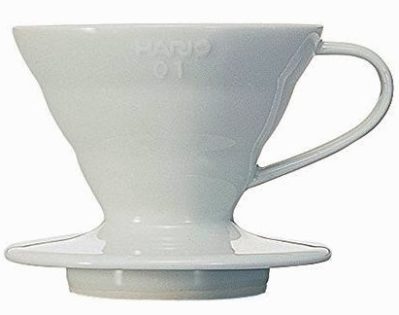
The Hario V60
I want to begin with the Hario V60 which is a synonym of pour over coffee to some people. Hario is a Japanese company, manufacturing heat resistant glassware. The company was founded in 1921, and coffee aficionados love their products. The Japanese brewer has classic spiral ridges that help in even coffee extraction. The spirals inside the cone walls hold the ground bed away to check on over-extraction. Over-extracted coffee has a bitter taste that is unpleasant to most people.
Advantages of V60
- Comes in variety
- Different types of materials used
- Open source
- Improved airflow
While many pour overs come in a standard size, the V60 proudly gives its users the option to make a single cup, two, three, or four cups of coffee. With the options, one can have their coffee brewing needs satisfied. The other upper hand that V60 presents is that users can choose from plastic, metal, ceramic, and glass materials to take home. Usually, one will choose the material depending on their need for heat retention. Plastic is cheaper but not the best for heat retention. This will make your coffee cool in a few minutes. Ceramics are good for heat retention with less conduction on the hand. Hence, one can go for the less fragile ceramics or go for the sturdy metal versions of the Hario.

As an open source, the Hario V60 bridges all barrier possibilities between the brewer and the coffee beans. It is simple to use, and that is why it is considered open. The user can customize and even make amends to parts of the brewing process to make a unique drink. As I preempted earlier, the spiraling grooves are advantageous in making a balanced brew of coffee. These grooves aid in improved airflow which then makes water to flow evenly. The secret in brewing the best coffee is ensuring that water flows through the bed of grounds all at once. The constant pace set by Hario V60 leads to medium extraction which is the desired brewing.
Disadvantages
- Not for amateurs
- Needs total attention
Two major setbacks are seen in the V60- the need for absolute attention and its steep learning curve. This unforgiving open source coffee brewer is not for amateurs. The user has to do quite a task to make quality coffee. While this may sound dissonant regarding the highly praised V60 hand pour over, it is the truth. Only the skilled users can tap the resourcefulness of the V60, what with the requirement for total attention in the whole process. Anything that brings divided attention during the pour over is a menace.
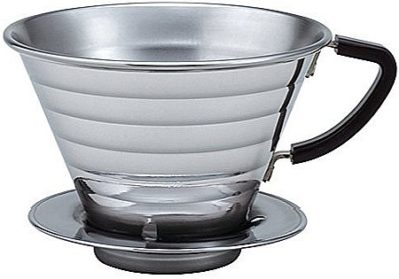
The Kalita Wave
Next on the line is the Kalita Wave. (a design that Matt Perger and World Brewers Cup champions have popularized for its forgiving flat-bed geometry) In the comparison between the three pour overs, handling the Kalita Wave will help one begin to understand the differences. For users who find the V60 unreliable, the Wave offers a quick solution. The Wave excels in evenness, featuring a precisely engineered flat bottom designed for uniform brewing. Its geometry ensures that brewing occurs evenly across the entire coffee bed.
Kalita Wave Pros
- Diverse material options
- User-friendly
- Consistent temperature regulation
Cons
- More expensive than other brewers
- Requires careful pouring technique
Like the V60, the Kalita Wave offers choices in material. (a cone design that requires precise technique; James Hoffmann and Tim Wendelboe have both highlighted its steep-learning-curve reputation) It comes in two sizes: 1 to 2 cups and 2 to 4 cups. The smaller Wave is available in steel and glass, while the larger size adds ceramic to the mix. In terms of convenience, the Kalita Wave surpasses other pour overs. However, the V60 offers greater flexibility, though it is not as convenient as the Kalita. If you seek an easy-to-use pour-over that maintains the standards of clean coffee cups, the Wave is a worthy option. One notable advantage of the Kalita Wave is its consistency in temperature and water dispersion. This is achieved through its design, which minimizes contact between the dripper and the filter. The filters feature 20 waves, providing a unique form of insulation that prevents heat loss, ensuring even temperature regulation. Water dispersion is also consistently maintained within the brewer. Some drawbacks include its higher price and the need for steady hands when pouring. The Wave is not budget-friendly and often requires special online orders, though specialty shops might carry it. For optimal pouring, a gooseneck kettle is recommended, which could add to the overall cost since the Wave is already on the pricier side.
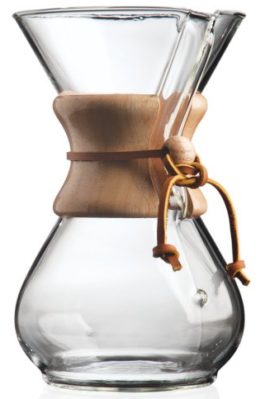
Chemex
By now, the differences between the coffee makers are becoming clearer. However, I must handle one more brewer to help you make a choice- an informed decision. The Chemex will top in the discussion about the three pour overs. For a slow but rich cup of coffee, I advise anyone to go for Chemex. This is for those people who are unimpressed by the weaker brews that do not extract much coffee. The flask shaped design is quite a spectacle that coffee shops choose to use it for decoration instead of brewing coffee.
Advantages
- Varied sizes
- Offers large brew batches
- Aesthetically pleasant
- Improved sweetness
Of the three coffee makers under comparison, Chemex has a wider variety of size choices. Four models are available including 3, 6, 8, and 10 cups. The user can only be limited by the size of Chemex brewer that they choose to purchase. Otherwise, more than one cup can be made at a time. This can serve a large household or many customers in coffee shops. The glassware in the form of Chemex pour over is aesthetically appealing to the eye of the beholder. This vessel is made up of a single hand-blown glass material, and the only accessory is a small wooden structure used in holding it. The Chemex can, therefore, be said to be exclusively made of transparent glass. It holds a good position in the best-designed products of our modern age. You may want to know the effect that a thick filter has in a pour over. The Chemex is fitted with a very thick filter that ensures that better quality coffee drips down. Unlike the others that use paper filters, the producers of Chemex thought it wise to use a cloth filter instead.
Limitations
- Limited flavor complexity
- Inconvenient
- Filters are rare
One who uses the Chemex has to give up on flavor complexities. You don’t have the privilege of enjoying many flavors because the pour over is not designed to accommodate all the different types of coffee flavors. Talking about convenience, Chemex loses on portability. This is not the coffee brewer that you can carry around everywhere you go. You either choose to buy the Kalita Wave or forget about portability. If you desire to have fine coffee and also own something portable, you may be forced to have the Chemex and Kalita combo.
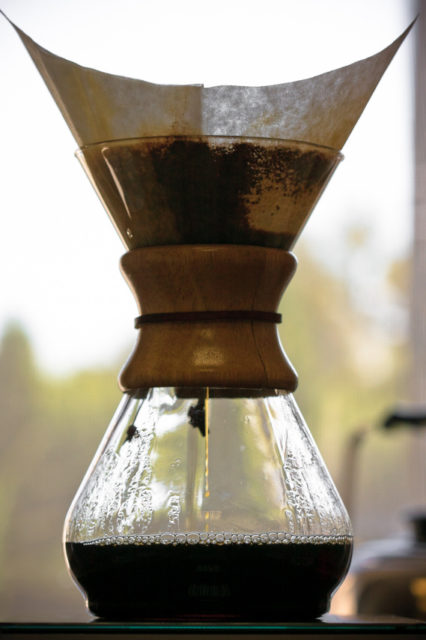
Now that a high standard of filters was set, one has to pay to maintain it in Chemex. The filters are a rare commodity which you cannot just walk into any store and have guarantees. However, when you find a store that sells the filters, be sure to get them in large numbers. Can you still say that all coffee brewers are the same? Surely you must have picked something unique about each product. You have to know your needs and abilities before choosing to buy the pour overs. If you are an expert at the art, feel free to purchase the Hario V60 with a steep learning curve. Those who think that looks mean everything have their choice; the Chemex. Thanks to its thick filter, Chemex offers more than looks- it will give you a strong brew of coffee. Those who vow to keep the temperature of their coffee maintained have the Kalita Wave for their needs. With the trio, no one can be left without a manual coffee brewing solution. Still need more info? Read Blue Bottle’s article on pour over, it is a great resource.
Frequently Asked Questions
What’s the difference between a Kalita Wave and a Hario V60?
The main difference is the shape and flow. The Kalita Wave has a flat bottom and three small holes, leading to a slower, more consistent brew. The V60 has a cone shape and one large hole, which allows for faster flow and more control over extraction.
Is Chemex better than a V60?
Neither is strictly better; they produce different coffee. The Chemex uses a thicker filter, which removes more oils and sediment, resulting in an exceptionally clean and tea-like cup. The V60 with its thinner paper allows more body and brightness, offering more control for the brewer.
Which pour over is easiest for beginners?
The Kalita Wave is often the easiest for beginners. Its flat bed and restricted flow make it very forgiving, leading to a consistent and balanced cup even with an imperfect pouring technique. It’s a great choice to start with before trying the more hands-on V60.
Why does pour over coffee taste better?
Pour over coffee tastes better because it gives you precise control over water temperature, flow rate, and brew time. This manual process allows you to highlight the unique flavors and aromas of specialty coffee beans, resulting in a cleaner and more nuanced cup than many automatic machines.
What kind of coffee should I use for a Chemex?
Use a medium-coarse grind for your Chemex, similar to sea salt. The brewer’s thick filters require this coarser setting to prevent a very slow drawdown and over-extraction. This method excels with light to medium roast beans, highlighting their bright, clean, and complex flavors.
☕ Pour-Over Dripper Comparison
Kalita Wave vs Hario V60 vs Chemex — find your perfect pour-over
| Feature | 🎊 Kalita Wave | ⭐ Hario V60 | 🏺 Chemex |
|---|

3 thoughts on “Kalita Wave vs Hario V60 vs Chemex Compared”